Genres
Similar Artists








Hire Chicago for Your Event
We Help You Hire, Book and Produce a Chicago Concert Performance
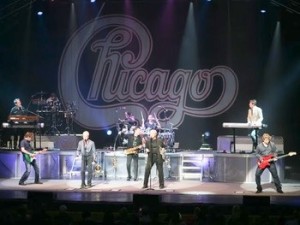
Celebrity Direct Inc. will help you select, book and hire Chicago to perform at your corporate event, nonprofit event or private performance.
We are always uniquely positioned as your advocate throughout the hiring process and we won’t let you overpay.
Contact us for availability, price and other production details at:
__________
Chicago Songs
- “Saturday in the Park”
- “Colour My World”
- “Questions 68 & 69”
- “25 or 6 to 4”
- “Feelin’ Stronger Everyday”
- “You’re the Inspiration”
- “Does Anyone Really Know What Time It Is?”
- “If You Leave Me Now”
- “No Tell Lover”
- “Hard to Say I’m Sorry”
__________
Chicago Bio
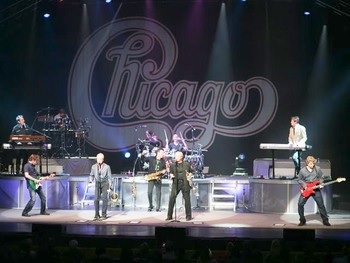
The band Chicago is second only to the Beach Boys as the most successful American rock band of all time, in terms of both albums and singles. Judged by album sales, as certified by the R.I.A.A., the band does not rank quite so high, but it is still among the Top Ten best-selling U.S. groups ever. If such statements of fact surprise, that’s because Chicago has been singularly underrated since the beginning of its long career, both because of its musical ambitions (to the musicians, rock is only one of several styles of music to be used and blended, along with classical, jazz, R&B, and pop) and because of its refusal to emphasize celebrity over the music. The result has been that fundamentalist rock critics have consistently failed to appreciate its music and that its media profile has always been low. At the same time, however, Chicago has succeeded in the ways it intended to. From the beginning of its emergence as a national act, it has been able to fill arenas with satisfied fans. And beyond the impressive sales and chart statistics, its music has endured, played constantly on the radio and instantly familiar to tens of millions. When, in 2002, Chicago’s biggest hits were assembled together on the two-disc set The Very Best of Chicago: Only the Beginning and the album debuted in the Top 50, giving the band the distinction of having had chart albums in five consecutive decades, the music industry and some music journalists may have been startled. But the fans who had been supporting Chicago for over 30 years were not.
Chicago marked the confluence of two distinct, but intermingling musical strains in Chicago, IL, in the mid-’60s: an academic approach and one coming from the streets. Reed player Walter Parazaider (born March 14, 1945, in Chicago, IL), trumpeter Lee Loughnane (born October 21, 1946, in Chicago, IL), and trombonist James Pankow (born August 20, 1947, in St. Louis, MO) were all music students at DePaul University. But they moonlighted in the city’s clubs, playing everything from R&B to Irish music, and there they encountered less-formally educated, but no-less-talented players like guitarist Terry Kath (born January 31, 1946, in Chicago, IL; died January 23, 1978, in Los Angeles, CA) and drummer Danny Seraphine (born August 28, 1948, in Chicago, IL). In the mid-’60s, most rock groups followed the instrumentation of the Beatles — two guitars, bass, and drums — and horn sections were heard only in R&B. But in the summer of 1966, the Beatles used horns on “Got to Get You into My Life” on their Revolver album and, as usual, pop music began to follow their lead. At the end of the year, the Buckinghams, a Chicago band guided by a friend of Parazaider’s, James William Guercio, scored a national hit with the horn-filled “Kind of a Drag,” which went on to hit number one in February 1967.
That was all the encouragement Parazaider and his friends needed. Parazaider called a meeting of the band-to-be at his apartment on February 15, 1967, inviting along a talented organist and singer he had run across, Robert Lamm (born October 13, 1944, in New York, NY [Brooklyn]). Lamm agreed to join and also said he could supply the missing bass sounds to the ensemble using the organ’s foot pedals (a skill he had not actually acquired at the time).
Developing a repertoire of James Brown and Wilson Pickett material, the new band rehearsed in Parazaider’s parents’ basement before beginning to get gigs around town under the name the Big Thing. Soon, they were playing around the Midwest. By this time, Guercio had become a staff producer at Columbia Records, and he encouraged the band to begin developing original songs. Kath, and especially Lamm, took up the suggestion. (Soon, Pankow also became a major writer for the band.) Meanwhile, the sextet became a septet when Peter Cetera (born September 13, 1944, in Chicago, IL), singer and bassist for a rival Midwest band, the Exceptions, agreed to defect and join the Big Thing. This gave the group the unusual versatility of having three lead singers, the smooth baritone Lamm, the gruff baritone Kath, and Cetera, who was an elastic tenor. When Guercio came back to see the group in the late winter of 1968, he deemed them ready for the next step. In June 1968, he financed their move to Los Angeles.
Guercio exerted a powerful influence on the band as its manager and producer, which would become a problem over time. At first, the bandmembers were willing to live together in a two-bedroom house, practice all the time, and change the group’s name to one of Guercio’s choosing, Chicago Transit Authority. Guercio’s growing power at Columbia Records enabled him to get the band signed there and to set in place the unusual image the band would have. He convinced the label to let this neophyte band release a double album as its debut (that is, when they agreed to a cut in their royalties), and he decided the group would be represented on the cover by a logo instead of a photograph.
Chicago Transit Authority, released in April 1969, debuted on the charts in May as the band began touring nationally. By July, the album had reached the Top 20, without benefit of a hit single. It had been taken up by the free-form FM rock stations and become an underground hit. It was certified gold by the end of the year and eventually went on to sell more than two million copies. (In September 1969, the band played the Toronto Rock ‘n’ Roll Festival, and somehow the promoter obtained the right to tape the show. That same low-fidelity tape has turned up in an endless series of albums ever since. Examples include: Anthology, Beat the Bootleggers: Live 1967, Beginnings, Beginnings Live, Chicago [Classic World], Chicago Live, Chicago Transit Authority: Live in Concert [Magnum], Chicago Transit Authority: Live in Concert [Onyx], Great Chicago in Concert, I’m a Man, In Concert [Digmode], In Concert [Pilz], Live! [Columbia River], Live [LaserLight], Live Chicago, Live in Concert, Live in Toronto, Live ’69, Live 25 or 6 to 4, The Masters, Rock in Toronto, and Toronto Rock ‘n’ Roll Revival.) To Guercio’s surprise, he was contacted by the real Chicago Transit Authority, which objected to the band’s use of the name; he responded by shortening the name to simply “Chicago.” When he and the group finished the second album (another double) for release at the start of 1970, it was called Chicago, though it has since become known as Chicago II.
Chicago II vaulted into the Top Ten in its second week on the Billboard chart, even before its first single, “Make Me Smile,” hit the Hot 100. The single was an excerpt from a musical suite, and the band at first objected to the editing considered necessary to prepare it for AM radio play. But it went on to reach the Top Ten, as did its successor, “25 or 6 to 4.” The album quickly went gold and eventually platinum. In the fall of 1970, Columbia Records released “Does Anybody Really Know What Time It Is?,” drawn from the group’s first album, as its next single; it gave them their third consecutive Top Ten hit.
Chicago III, another double album, was ready for release at the start of 1971, and it just missed hitting number one while giving the band a third gold (and later platinum) LP. Its singles did not reach the Top Ten, however, and Columbia again reached back, releasing “Beginnings” (from the first album) backed with “Colour My World” (from the second) to give Chicago its fourth Top Ten single. Next up was a live album, the four-disc box set Chicago at Carnegie Hall, which, despite its size, crested in the Top Five and sold over a million copies. (The band itself preferred Live in Japan, an album recorded in February 1972 and initially released only in Japan.) Chicago V, a one-LP set, released in July 1972, spent nine weeks at number one on its way to selling over two million copies, spurred by its gold-selling Top Ten hit “Saturday in the Park.” Chicago VI followed a year later and repeated the same success, launching the Top Ten singles “Feelin’ Stronger Every Day” and “Just You ‘n’ Me.”
The next Top Ten hit, “(I’ve Been) Searchin’ So Long,” was released in advance of Chicago VII in the late winter of 1974. The album was the band’s third consecutive chart-topper and another million-seller. “Call on Me” became its second Top Ten single. Chicago VIII, which marked the promotion of sideman percussionist Laudir de Oliveira as a full-fledged bandmember, appeared in the spring of 1975, spawned the Top Ten hit “Old Days,” and became the band’s fourth consecutive number one LP. After the profit-taking Chicago IX — Chicago’s Greatest Hits in the fall of 1975 came Chicago X, which missed hitting number one but eventually sold over two million copies, in part because of the inclusion of the Grammy-winning number one single “If You Leave Me Now.” Chicago XI, released in the late summer of 1977, continued the seemingly endless string of success, reaching the Top Ten, selling a million copies, and generating the Top Five hit “Baby, What a Big Surprise.”
But there was trouble beneath the surface. The band’s big hits were starting to be solely ballads sung by Cetera, which frustrated the musicians’ musical ambitions. They had failed to attract critical notice, and what press attention they were given often alluded to Guercio’s Svengali-like control as manager and producer. Chicago determined to fire Guercio and demonstrate that they could succeed without him. Shortly afterward, they were struck by a crushing blow. Kath, a gun enthusiast, accidentally shot and killed himself on January 23, 1978. Though he, like most of the other members of the band, was not readily recognizable outside the group, he had actually had a large say in its direction, and his loss was incalculable. Nevertheless, the band closed ranks and went on.
Guitarist Donnie Dacus was chosen from auditions and joined the band in time for its 12th LP release, which was given a non-numerical title, Hot Streets, and which put prominent pictures of the bandmembers on the cover for the first time. The sound, as indicated by the first single, the Top 20 hit “Alive Again,” was harder rock, and the band’s core following responded, but Hot Streets was Chicago’s first album since 1969 to miss the Top Ten. Chicago 13 then missed the Top 20. (At this point, Dacus left the band, and Chicago hired guitarist Chris Pinnick as a sideman, eventually upping him to full-fledged group-member status.) 1980’s Chicago XIV, the last album to feature de Oliveira, didn’t go gold. By 1981, with the release of the 15th album, the poor-selling Chicago — Greatest Hits, Vol. 2, the band parted ways with Columbia Records and began looking for a new approach.
They found it in writer-producer David Foster, who returned to an emphasis on the band’s talent for power ballads as sung by Cetera. They also brought in one of Foster’s favorite session musicians, Bill Champlin (born May 21, 1947, in Oakland, CA), as a full-fledged bandmember. Champlin, formerly the leader of the Sons of Champlin, was a multi-instrumentalist with a gruff voice that allowed him to sing the parts previously taken by Kath. With these additions, the band signed with Full Moon Records, an imprint of Warner Bros., and released Chicago 16 in the spring of 1982, prefaced by the single “Hard to Say I’m Sorry,” which topped the charts, leading to a major comeback. The album returned Chicago to million-selling, Top Ten status. Chicago 17, released in the spring of 1984, was even more successful — in fact, the biggest-selling album of the band’s career, with platinum certifications for six million copies as of 1997. It spawned two Top Five hits, “Hard Habit to Break” and “You’re the Inspiration.”
The renewed success, however, changed the long-established group dynamics, thrusting Cetera out as a star. He left the band for a solo career in 1985. (Pinnick also left at about this time, and the band did not immediately bring in a new guitarist.) As Cetera’s replacement, Chicago found Jason Scheff, the 23-year-old bass-playing son of famed bassist Jerry Scheff, a longtime sideman with Elvis Presley. Scheff boasted a tenor voice that allowed him to re-create Cetera’s singing on many Chicago hits. The split with Cetera had a negative commercial impact, however. Despite boasting a Top Five hit single in “Will You Still Love Me?,” 1986’s Chicago 18 only went gold. The band recovered, however, with Chicago 19, released in the spring of 1988. Among its singles, “I Don’t Want to Live Without Your Love” made the Top Five, “Look Away” topped the charts, and “You’re Not Alone” made the Top Ten as the album went platinum. Another single, “What Kind of Man Would I Be?,” originally found on the album, was included as part of the 1989 compilation Greatest Hits 1982-1989 (which counted as the 20th album) and became a Top Five hit, while the album sold five million copies by 1997.
At the turn of the decade, Chicago underwent two more personnel changes, with guitarist DaWayne Bailey joining and original drummer Danny Seraphine departing, to be replaced by Tris Imboden. Chicago Twenty 1, released at the start of 1991, sold disappointingly, and Warner rejected the band’s next offering (though tracks from it have turned up on compilations). Chicago, however, maintained a loyal following that enabled it to tour successfully every summer. In 1995, Keith Howland replaced Bailey as Chicago’s guitarist. The same year, the band regained rights to its Columbia Records catalog and established its own Chicago Records label to reissue the albums. They also signed to Giant Records, another Warner imprint, to release their 22nd album, Night & Day, a collection of big band standards that made the Top 100. They were now able to combine hits from their Columbia and Warner years, resulting in the release of the gold-selling The Heart of Chicago 1967-1997 and its follow-up, The Heart of Chicago, Vol. 2 1967-1998 (their 23rd and 24th albums, respectively). In 1998, they released Chicago 25: The Christmas Album on Chicago Records, and they followed it in 1999 with Chicago XXVI: The Live Album. In 2002, Chicago began leasing its early albums to Rhino Records for deluxe repackagings, often with bonus tracks. And the success of The Very Best of Chicago: Only the Beginning demonstrated that their music continued to appeal to fans.
__________
How do I hire Chicago for a private event, corporate event, nonprofit gala or convention?
To hire Chicago for a private or corporate performance, the event buyer must first determine whether the artist is available and interested in the proposed engagement and then submit an offer through the appropriate authorized representative. The offer typically includes the event date and location, type of event, proposed performance format and fee.
Celebrity Direct represents event buyers throughout this process, including availability inquiries, offer strategy, negotiation, contracting, rider review and production coordination.
How much does it cost to hire Chicago for a private or corporate event?
There is no single published fee to hire Chicago for a private or corporate event. The performance fee is negotiated for the specific engagement and can vary based on the date, location, event type, performance format, travel requirements, current touring activity and other circumstances surrounding the event.
Celebrity Direct can obtain current availability and pricing from the appropriate artist representative for a specific event.
What total budget should I expect when hiring Chicago?
The total cost of presenting Chicago can be higher than the negotiated artist performance fee. Depending on the engagement, additional expenses can include airfare or private aviation, hotels, local transportation, sound, lighting, staging, backline, labor, hospitality and other requirements contained in the artist’s rider.
For this reason, event buyers should evaluate the all-in cost of the performance, not simply the artist fee, before making an offer.
How can I find out if Chicago is available for my event date?
Chicago’s availability for a private or corporate event must be confirmed through the appropriate authorized representative. Availability can depend on touring and recording commitments, personal scheduling, event location, travel requirements and whether the artist is interested in the particular engagement.
Celebrity Direct can submit the event details, check availability and determine whether an offer is appropriate.
How do I contact Chicago’s booking agent about a private performance?
A corporate, nonprofit or private-event buyer generally does not need to locate Chicago’s booking agent personally. An experienced talent buyer can identify the appropriate authorized representative, present the event professionally and manage the inquiry and offer process on the buyer’s behalf.
Celebrity Direct handles this process for its clients and represents the event buyer rather than the artist.
How do I contact Chicago’s manager about hiring them for an event?
Artist management is not necessarily the appropriate first contact for negotiating a private performance. Celebrity engagements are generally handled through the artist’s authorized booking representation, management or another designated representative depending on the circumstances.
Celebrity Direct determines the appropriate contact for the proposed engagement and handles the communication and negotiation for the event buyer.
Will Chicago perform at a corporate event, convention, nonprofit gala or private party?
Whether Chicago will consider a particular private or corporate performance depends on their availability, the nature and location of the event, the proposed performance, the financial offer and artist approval. Celebrity artists are not simply available for every event at a published price.
A legitimate inquiry should therefore include enough information about the event for the artist’s representatives to evaluate the opportunity.
What information do I need before asking about hiring Chicago?
Before requesting availability or pricing for Chicago, an event buyer should ideally know the event date, city and venue, type of event, expected attendance, desired performance format and approximate entertainment budget.
Providing these details allows the artist’s representatives to evaluate the engagement and allows an experienced talent buyer to recommend the most effective offer strategy.
Does the quoted artist fee include travel and production?
Usually, the artist’s performance fee should not be assumed to represent the complete cost of the engagement. Travel, hotels, ground transportation, production, equipment, labor and hospitality requirements may be additional obligations of the buyer depending on the negotiated contract and rider.
The contract and rider should be reviewed before the event buyer determines the final entertainment budget.
Can Celebrity Direct handle the complete Chicago booking and production process?
Celebrity Direct can represent the event buyer throughout a celebrity entertainment engagement, including determining availability, developing the offer, negotiating with the artist’s authorized representative, reviewing contracts and riders, coordinating production requirements and assisting with the performance through event day.
Unlike an artist’s agent or manager, Celebrity Direct works on the buyer’s side of the transaction, helping the event planner understand the financial, contractual and production obligations involved in presenting celebrity talent.
The Celebrity Booking Process
How Do I Hire a Celebrity for a Corporate or Private Event?
Submit a request
Submit our website form. We’ll ask you to provide a few key event details and budget goals
Consultation call
We’ll schedule a call to discuss your event goals, offering our expert guidance on expectations
Talent Curation
We Identify a shortlist of available talent, factoring in tour schedules, to ensure accurate recommendations
Narrow it Down
We’ll help you rank and narrow down your top 3 priority picks
The Firm Offer
We craft a formal offer and present it to the Artist
Contract + Deposit
If the offer is accepted, we issue your agreement. If declined, we move to your next preferred choice.
Why Work With Us
Not Just a Booking. A Full-Scale Production.
Booking a celebrity is only part of the equation. We build the entire experience around it.
We handle:
- Artist negotiation and contracting
- All production: staging, lighting, sound, technical riders
- Event logistics and show advancement
- VIP coordinators, security, and confidentiality
You get:
- A seasoned producer and booking advisor in one
- A direct line to the decision-makers behind the artist
- A one-stop solution from inquiry to showtime
- Peace of mind knowing every detail is managed